GS1 Sunrise 2027 Technical Integration Guide for CPG Brands
The Technical Integration Guide for Emerging and Enterprise Brands
September 3, 2026
GS1 Sunrise 2027 compliance takes more than a compliance code
Our last blog post made the business case for GS1 Sunrise 2027: comply with the mandate, but don't stop there. This post is the follow-up for the people who have to actually build it - what a GS1-compliant 2D barcode requires technically, what "dynamic" means in practice, and what the integration path looks like depending on the size and complexity of your brand.
To meet the January 2027 deadline and get real value out of it, a brand needs a platform that gets three things right: exact technical compliance with GS1 standard, a dynamic code that can be updated with packaging reprints, and an infastructure stack that scales from an emerging brand's first build to an enterprise brand's full integration with their existing tech stack. Everything below breaks down what each of those three actually requires.

Don't link QR codes to your homepage
Linking a generated QR code that you create to your homepage creates a poor customer experience that lacks relevant and contextual information.
Read MoreWhat does GS1 compliance actually require from a platform?
There's no formal certification or partnership that makes a platform "GS1-approved." What matters instead is whether the platform's output actually meets the specs, and this one doesn't leave much wiggle room.
The GTIN has to be the brand's own.
A brand registers its own GTIN through its GS1 Company Prefix, licensed via GS1 US. No platform can create or assign that number on a brand's behalf. Pricing scales with volume - about $30 for a single GTIN with no renewal fee, or roughly $750 upfront plus $150/year for a prefix covering 100 products.
The URL syntax has to be exact.
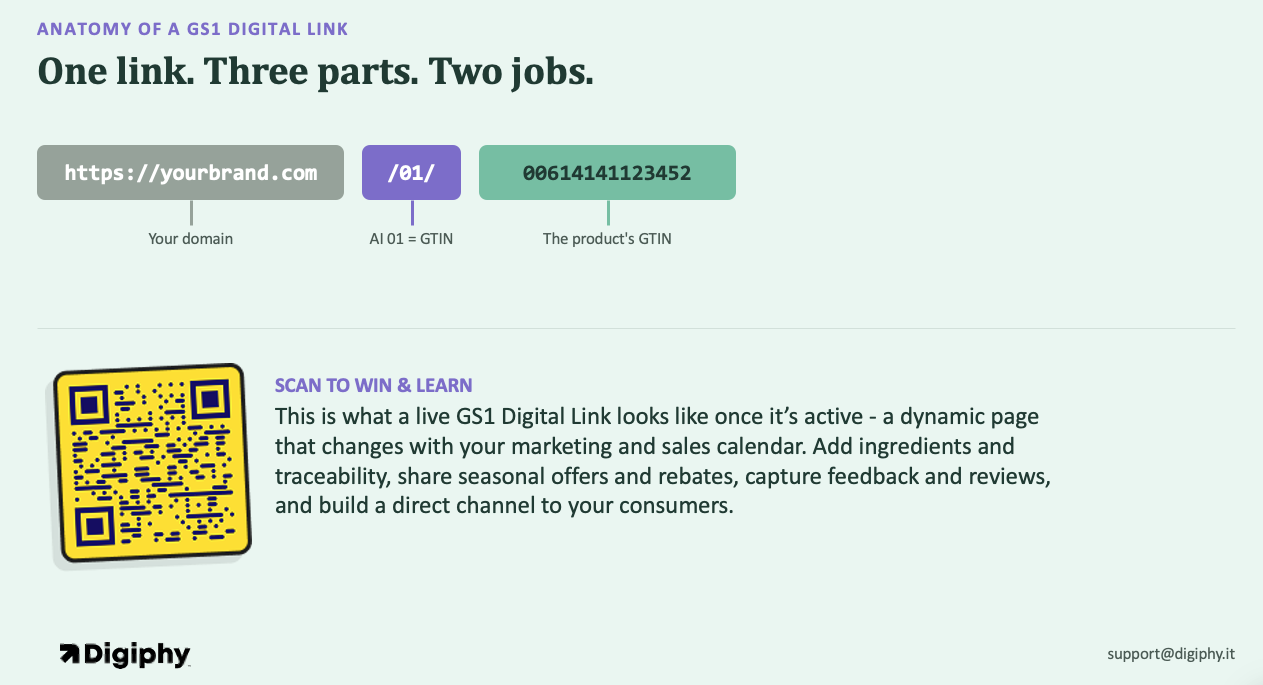
A GS1 Digital Link follows a precise structure, with the GTIN represented by its GS1 Application Identifier (A1 01) in a specific position in the URI. Formatting even slightly off, and retailer point-of-sale scanners reject the code outright.
The barcode has to carry the correct encoding.
The physical QR code needs proper FNC1 application-identifier encoding so checkout systems read it as a genuine GS1 data carrier - not a generic QR code that happens to contain a link. This is what lets one code serve two readers: a retailer's scanner extracts the GTIN as product identity, while a consumer's phone resolves the full link to whatever content the brand configures.
Digiphy's codes are built to satisfy all three: brands connect their own registered GTIN, the URI syntax follows the GS1 spec exactly, and the barcode carries the FNC1 encoding checkout systems require.
Can a GS1 QR code be dynamic and updated after printing?
Most marketing QR codes are static - the destination is fixed to the URL at the moment of printing, and changing it means reprinting packaging. Any brand who has experienced this can share how painful it is. A GS1 Digital Link can be dynamic. Dynamic codes mean the printed code never change, but the destination behind it can be updated at any time - new offers and rebates, new content, rotating giveaways and contests, a different upsell path, a new survey - all without touching the package or the print run.
Every code Digiphy generates is dynamic by default, and can be mapped to a brand's own domain, so the link a customer's phone resolves to reads as yourbrand.com/.... rather than a third-party generator's URL. This means you own the QR code and adds an extra layer of flexibility if you ever want to leave a platform. Since it looks and feels like the brand, it adds an extra layer of trust at the point of scan, brand alignment, and keeps scan traffic and data tied to a domain the brand controls. At DIgiphy, we offer domain mapping for a brand's digital link pages, as well.
What's the difference between GS1 integration for emerging vs. enterprise brands?
What you actually need here is genuinely different depending on where you're starting from and what size brand you are. A brand building its first packaging experience needs something different than one adding onto systems it already has. Knowing which one you are is what keeps you from underbuilding, or overbuilding for problems you don't have yet.
An emerging brand needs a working foundation:
A GS1 Digital Link that scans correctly at retail checkout, a content page that can include some combination of modules - for ingredients and traceability, receipt-verified offers and rebates, consented data capture (name, email, phone, etc), a lightweight survey mechanism, giveaways or contests, marketing and pixel integration (Google, Meta, TikTok), and a connection into whatever CRM or email/SMS platform is already running. The latter is not always necessary because data can be stored in Digiphy and marketing messaging can run from Digiphy's SMS and email system. That stack alone turns the compliance requirement into a working acquisition and retention channel - no CDP or custom development required.
An enterprise brand needs everything above, plus systems most emerging brands haven't hit yet:
Traceability infrastructure for batch/lot serialization data (relevant to FSMA 204 and similar frameworks), CDP integrations so scan data joins the brand's unified customer profile, deeper CRM integration with custom field mapping, and custom domain mapping on QR and digital links with API for webhook access so an internal engineering team can build on the data directly. Enterprise integrations are additive to the emerging-brand stack, not a replacement for it.
Two things worth planning regardless of tier: data and privacy consent (every capture point above can collect PII, and consent needs to be built into the flow from the star, not added after), and print/QA verification (a code that resolves correctly in a design file can still fail in the real world depending on print quality and substrate - test against both POS scanners and phone cameras before a run ships.) Brands selling internationally should also confirm GTIN registration requirements with the relevant GS1 member organization in each market. For privacy consent, all Digiphy forms have explicity opt-ins for data collected and if messaging is sent via our platform, STOP messages are collected and automatically opt-out individuals.
Frequently asked questions
Do I need a GS1 Company Prefix to make a QR code GS1 compliant?
Yes. A GS! Company Prefix, licensed through GS1 US, is what allows a brand to register its own GTINs - without it, there's not legitmate GTIN to encode into a compliant Digital Link.
Is a GS1 Digital Link the same as a regular QR code?
No. A regular QR code can point anywhere and follow any format. A GS1 Digital Link follows a specific URI syntax defined by GS1, with the GTIN encoded using its official Application Identifier, and the physical barcode carries FNC1 encoding so retail scanners recognize it has a GS1 data carrier rather than a generic link.
Can GS1 code work for both retailer checkout and consumer engagement?
Yes, that's the core design of the format. A retailer's point-of-sale scanner reads the GTIN portion of the product identity, while a consumer's phone camera resolves the full URI and can be routed to content, offers, rebates, or any URL destination the brand configures.
When is the GS1 Sunrise 2027 deadline?
January 2027 is the target date by which retailers are moving toward accepting, and eventually requiring, 2D barcodes carryiing GTIN data at checkout. Most major national retailers will be compliant by then while smaller regional chains will likely not. For brands, enterprise brands are adding QR codes and the GTIN barcode to packaging and will soon migrate to just one. We don't think most emerging brands will be compliant as many aren't even aware of the changes.
The bottom line
Compliance itself is the same requirement for every brand. What a brand builds on top of it is a question of infrastructure - exact technical compliance, dynamic and not static, and scoped to your content needs whether you're an emerging and enterprise brand.
Digiphy covers all three: GS1-compliant, dynamic by default, and built to scale from emerging brand's first code to an enterprise brand's full integration stack. That infrastructure does something else, too - it lets you engage consumers directly, regardless of purchase channel, and finally see who they are, where they shop, and what they buy, without the retailer standing in the way. That's consumer data and insights most brands have never had access to.
None of it works without a reason for the consumer scan in the first place. A code that's technically perfect and fully integrated still won't move anyone to pull out their phone if there's nothing worth having on the other side. The call-to-action has to offer real value - a rebate, a chance to win, information a customer can't already get from the label. Get that right, and everything above turns a scan into a customer. Skip it, and the infrastructure has nothing to work with. We see call-to-actions like: Scan to Win, Scan for Free, Scan for Offer work best.
One code and one scan. That’s the whole difference between a customer you’ll never hear from again, and one you actually know and own.
Digiphy turns the code you're already required to print into an owned, always-on engagement channel - one that drives revenue and captures customer data, one scan at a time.
👉 Learn more or request access: https://www.digiphy.com
👉 Get in touch to book a demo.

Do More with Digiphy QR Codes
Capture the interest of your customers, interact with them directly, and boost your conversion rates.
Get Started!