
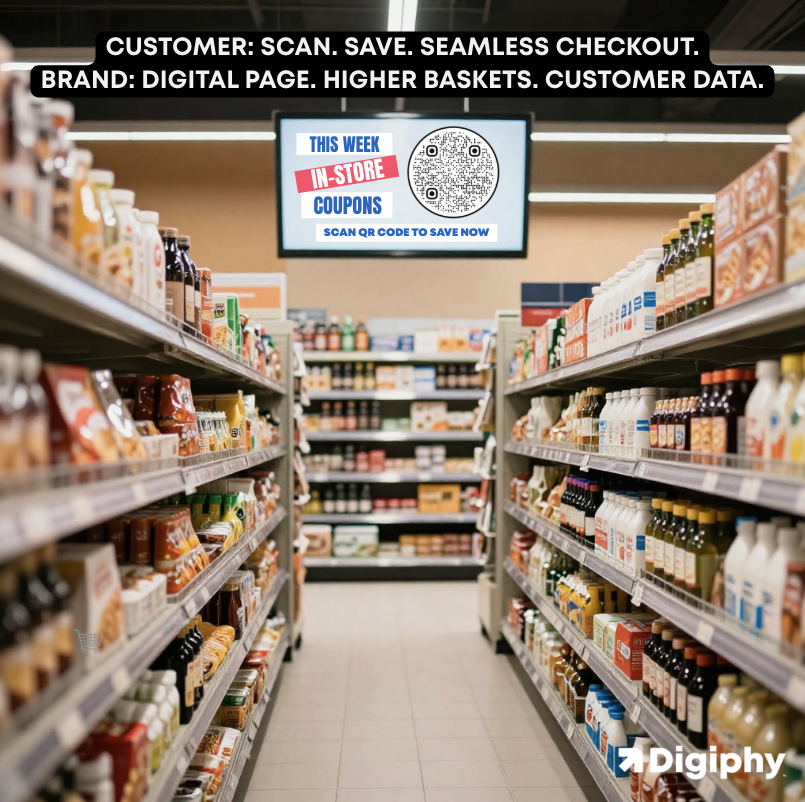
In-Store Retail Media: The Data Gap for CPG Brands
Brands are investing heavily on in-store ad screens, but getting no sales or engagement data back. Here's how a QR code changes that.
September 18, 2026
Retailers are pouring money into in-store digital ad screens right now, and they've even started proving these screens work with rough estimates. What they haven't done is give brands the same level of proof they keep for themselves. That's not an oversight. It's the business model. Here's the gap, and the one piece of technology that actually closes it for brands paying for the ad.
How much are retailers investing in in-store digital ad screens?
Kroger expects to roll out roughly 11,000 screens nationwide this year, with checkout ads live in about 7,00 stores. CVS is scaling toward a similar number, on top of digital end-caps already running in thousands of locations. Albertsons is adding screens to another 800 stores.
This is a new, sellable ad placement for each retailer's own Retail Media Network. Real infastrucutre spend, and it comes with the question every media buy eventually has to answer: did the screen work? Did it actually sell anything?
How do retailers measure whether their own screens work?
Albertsons has a genuine answer. They compare sales in stores running a given ad against sales in matched control stores that aren't, then attribute the difference to the campaign. That's a meaningful step forward, more rigorous than most retail media reporting has ever been.
It's still an estimate, though. A control-store comparison tells you a group of stores performed some percentage better than another group, on average. It doesn't tell you that the specific person who bought the product actually saw the screen. It's the retailer's best available inference, not a verified fact handed to the brand that paid for the placement.
Why don't brands get the same individual-level proof retailers already have?
Because retailers already have it, they just don't share it. Loyalty app like Kroger's app, CVS ExtraCare, Albertsons for U, tie every purchase to a real account and a real person, provided the shopper has the app on their device and uses it at checkout. That's genuine individual-level data. It's also data the retailer has every reason to keep or charge even more to access some small portion of.
The more a shopper's purchase history lives inside the retailer's own all, the more that relationship, and that data, stays with the retailer instead of the brand. What retailers hand back to brands instead is the aggregate, control-store version: a solid estimate, but not the individual-level truth the retailer gets.
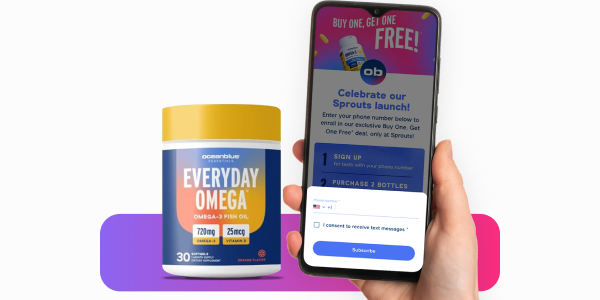
See the In-Store Rebate Customer Journey
Turn marketing dollars into measurable retail sales
Watch OceanBlue Omega + Digiphy In-Store Customer JourneyHow does a QR code close that gap for a brand?
A QR code on the same screen puts that individual-level proof back in the brand's hands. Instead of measuring exposure at the store level, it takes one specific shopper straight from the screen to their own device, and into a digital experience the brand controls: a coupon with a barcode to be used at checkout, and a giveaway on one page, collecting a name, email, and phone number before the offer unlocks.
One scan does three things at once:
- Streamlines checkout with a digital barcode instead of a physical coupon.
- Grows the basket by giving the shopper a reason to add more before they check out.
- Hands the brand real, individual-level data on exactly who converted, owned by the brand, not borrowed from a retailer's loyalty database.
Brands are already paying for the ad placement on the screen. The QR code is what turns that spend into owned data instead of a retailer's summary report.
See a regional groceries in-store digital experience from a QR code on digital screens, end-caps, and shelf-talkers.
What does this actually deliver, compared to a control-store estimate?
Control-store comparisons prove a media network works in aggregate. QR scans, opt-ins, and receipt-verified rebates prove it one consumer at a time, with data the brand can actually keep and use again. One brand saw a 47% sales lift running exactly this kind of receipt-verified program. No statistician required to explain why that number is real: every conversion behind it was confirmed, not inferred.
The bottom line
Retailers are going to keep investing in in-store screens, and they're going to keep getting better at proving those screens work, for themselves. That part of the story is already happening. The open question is whether brands keep paying for ad space and settling for an aggregate report, or use the same screen to walk away with a verified, individual, owned relationship with the customer who actually converted.
Digiphy turns the QR code on that same ad screen into a scan, a lead, an offer, and a verified purchase, connected end to end and owned by the brand. We give you the dynamic experience builder to capture consumer leads with a form connected directly to your CRM and SMS automations, digital barcode builder, and much more.
Book a meeting to see how it works.
Sources:
eMarketer (Albertsons control-store measurement, Kroger/CVS/Albertsons screen investment):
https://www.emarketer.com/content/in-store-retail-media-gets-boost-kroger-albertsons-cvs-expand-networks
Modern Retail (Kroger and CVS screen counts and rollout detail):
https://www.modernretail.co/marketing/retailers-like-kroger-cvs-plan-many-more-screens-for-in-store-ads-in-2026/
Retail News Asia (Hong Kong bakery case study — 30,000 members, 47% sales lift):
https://retailnews.asia/hong-kong-bakery-brand-builds-30000-members-without-retailer-pos-data

Leverage the Power of Retail Marketing
Get in touch to learn how Digiphy can help engage your customers at critical moments of interest.
Book a Demo
.png)